PR impact analysis moves risk assessment upstream into pull requests, automating the coordination overhead that justified sprint batching. This decouples release cadence from calendar intervals, enabling teams to ship when code is ready rather than when sprints end.
Why Sprint Cadence Became a Coordination Tax
Sprint cadence was never about giving developers time to code. It was about batching coordination overhead. When a coding task took three days, a two-week sprint made sense—you had time for planning, coding, review, integration, and retrospective. The rhythm absorbed the friction of aligning people, merging work, and validating changes.
AI-assisted tooling compresses coding from three days to three hours. The coordination activities—planning, review, integration, retrospective—now dominate the cycle. Between November 2024 and February 2026, AI adoption in engineering teams increased 65%, but throughput measured by pull request velocity moved less than 8%. The bottleneck shifted. Teams were writing code faster but shipping no faster, because the coordination tax stayed constant.
Sprint cadence became visible as overhead rather than structure. The rhythm that once made sense started to feel like artificial delay.
What PR Impact Analysis Actually Does
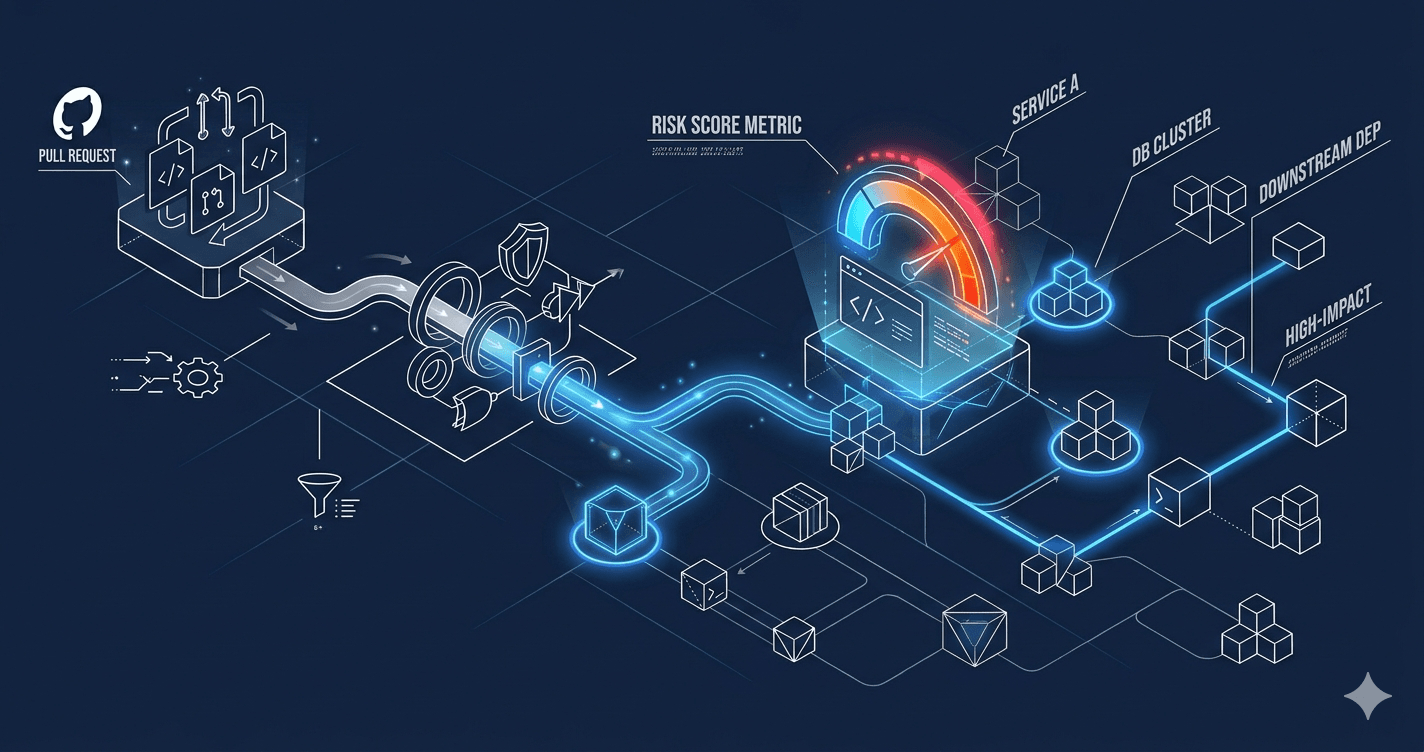
PR impact analysis moves risk assessment upstream, into the pull request itself. Instead of discovering blast radius during deployment or retrospective, you evaluate it when code is proposed. The tool analyzes dependency graphs, calculates risk scores, and surfaces the downstream services, databases, or APIs affected by the change—before merge.
Without this, teams rely on YAML catalogs that humans maintain or nightly grep scripts that produce stale maps. You learn the blast radius after the incident, not before the deploy. PR-time diffing changes that. When an agent or developer opens a pull request, the system answers: what breaks if this merges? What services call this endpoint? What configuration keys does this touch?
At Allegis Group, I led a 20+ engineer organization building AI-powered engineering platforms, including automated test generation, defect insight agents, and PR impact analysis. We built an AI-assisted release intelligence engine that calculates dynamic risk-scoring metrics for outbound software deployments, integrated directly into CI/CD pipelines. The system produced automated readiness gates—policy-driven checks that surface risk at the moment a PR is opened, not when a sprint ends.
This dropped manual QA and release overhead by 40–60% while accelerating cycle times. The coordination tax that justified batching—manual architectural sign-offs, siloed logging reviews, spreadsheet-driven release planning—disappeared because the risk evaluation happened continuously, not in sprint-boundary batches.
How It Changed Our Sprint Cadence
The coordination problem at Allegis was typical. Manual sign-offs from architects. Siloed logging that required human correlation. Release planning driven by spreadsheets and Slack threads. Every sprint boundary became a checkpoint, not because the code needed two weeks to write, but because evaluating readiness took that long.
We built the release intelligence engine to automate the "should we ship this?" decision. The system ingested PR metadata, static analysis output, and historical incident data. It produced a readiness score for each PR and flagged changes with high blast radius—those touching shared libraries, critical APIs, or cross-service contracts. Engineers saw the assessment in the PR interface. Reviewers saw the downstream impact. Product managers saw the deployment risk before the sprint demo.
This reduced release coordination overhead by roughly 50%. More importantly, it decoupled sprint cadence from readiness assessment. Teams could release mid-sprint if the risk score was low and the gates passed. They could delay a risky change without delaying the entire sprint. The rhythm stopped being the constraint because the tooling eliminated the need to batch coordination at fixed intervals.
This echoed work I did earlier at Capital One during the DevSecOps transformation. We constructed standardized CI/CD pipelines with integrated security gates, accelerating deployment velocities from multi-week release cycles down to on-demand automation, while slashing incident MTTR by 30%. The principle was the same: embed the risk assessment directly into the pipeline, automate the coordination tax, and let teams release when the code is ready, not when the calendar says so.
The "You Build You Own" model we adopted at Capital One shifted operational accountability into engineering teams. PR impact analysis extends that model—teams own the blast radius decision because the tooling makes the information available at the moment they need it.
The Incremental Release Advantage
PR-level risk gates enable safer, smaller deployments. Large configuration changes increase blast radius and risk. Mature systems apply adjustments incrementally and validate each step. When you can assess impact at the PR level, you can break a risky change into smaller pieces, ship each piece independently, and validate before moving to the next.
Without PR-time assessment, you batch changes because you lack confidence in the individual pieces. You wait for the sprint boundary, bundle multiple PRs into a release candidate, and hope the integration tests catch the interactions. This increases blast radius—more changes in flight, more potential failure modes, more rollback complexity.
At Warner Bros Discovery, I handled global production readiness and release execution for Max.com launches across 13 regions, achieving zero Sev-0 incidents during critical high-traffic milestones like the Paris Olympics. We served 100M+ subscribers reliably because we built operational playbooks, monitoring, and incident response frameworks that allowed us to assess risk before deploy. The difference with PR impact analysis is that assessment happens earlier—at code proposal, not at release candidate—so you can iterate on the blast radius before integration, not after.
Incremental releases with live validation reduce risk by limiting scope. If a PR touches three services, you can see which three before merge. If the blast radius is too wide, you refactor before approval. The coordination happens in the PR review, not in the post-deploy incident channel.
What We Learned About AI Tooling and Coordination
AI speeds up coding, but coordination remains human-bottlenecked without tooling. The 65% increase in AI adoption that produced an 8% throughput gain tells the story—teams wrote code faster but couldn't ship faster because the coordination activities didn't scale. PR impact analysis automates the "should we ship this?" decision by making blast radius visible at the moment code is proposed.
Sprint cadence stops being the constraint when risk is assessed continuously, not in batches. You still need planning rituals for focus and alignment—the cadence provides structure for deciding where to spend effort—but the rhythm no longer gates releases. Teams release when the code is ready and the risk is acceptable, not when the sprint ends.
The shift isn't from two-week sprints to one-week sprints. It's from cadence-driven coordination to continuous risk assessment. The tooling eliminates the need to batch because it eliminates the coordination tax that justified the batch in the first place.