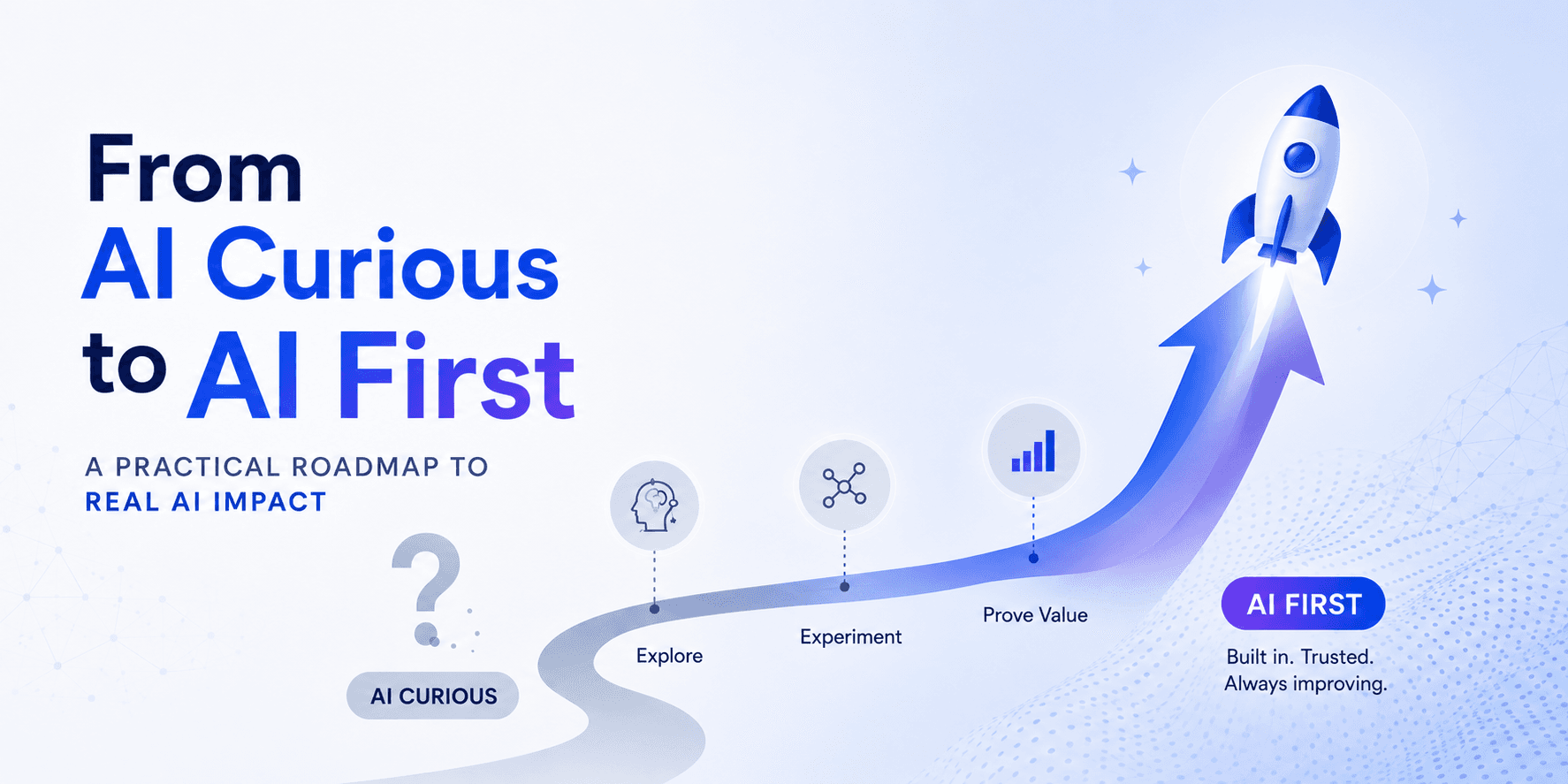
A field-tested maturity model for engineering managers adopting AI — four stages from Reactive Support to Governed AI-First, with a use-case selection checklist, metrics framework, and hard-won lessons.
Why This Matters Now
If you manage an engineering team today, you're probably feeling two pressures at once.
The first is real and internal: your engineers are buried in support tickets, deployment failures, test authoring, and release firefighting — time that should be going toward building features, not keeping the lights on.
The second is external and, frankly, less useful: a growing sense across most organizations that everyone needs to "show they're doing something with AI." Leadership wants a story. Competitors are announcing agents. It's easy for this to turn into a rat race — teams bolting AI onto whatever's visible, without asking whether it solves a real problem.
The approach that's worked for me is to opt out of the rat race and opt into a simpler discipline: pick AI use cases that have a clear business goal, a measurable outcome, a defined strategy, and a training plan for the people who'll use it. Everything in this paper follows from that one decision.
This isn't a vendor pitch or a "we've mastered AI" victory lap. It's a maturity model built from actually walking a team through it — including the parts we got wrong.
A Framework for Choosing Use Cases (Before You Touch a Tool)
Before picking any AI tool, ask four questions:
- Does it solve a measurable, existing pain point? Not a hypothetical one — something your team already complains about, with a number attached (hours, tickets, incidents).
- Can it fail safely? Early use cases should be reversible and low-stakes. You're building trust and skill, not betting the release.
- Do you have a baseline before you start? If you can't say "this took X hours/tickets/days before," you'll never be able to prove the after.
- Is there a training and visibility plan? Tools without skill-building create dependency, not capability. Visibility (demos, recognition) turns early adopters into internal advocates.
This checklist is the single most reusable thing in this paper. Apply it before every stage below.
The Maturity Model
AI adoption in an engineering org isn't a single leap — it's four stages, each with a Tools track, a People track, and a Process track that need to move together. Skipping a track in an early stage creates debt you pay for later (more on that in Lessons Learned).
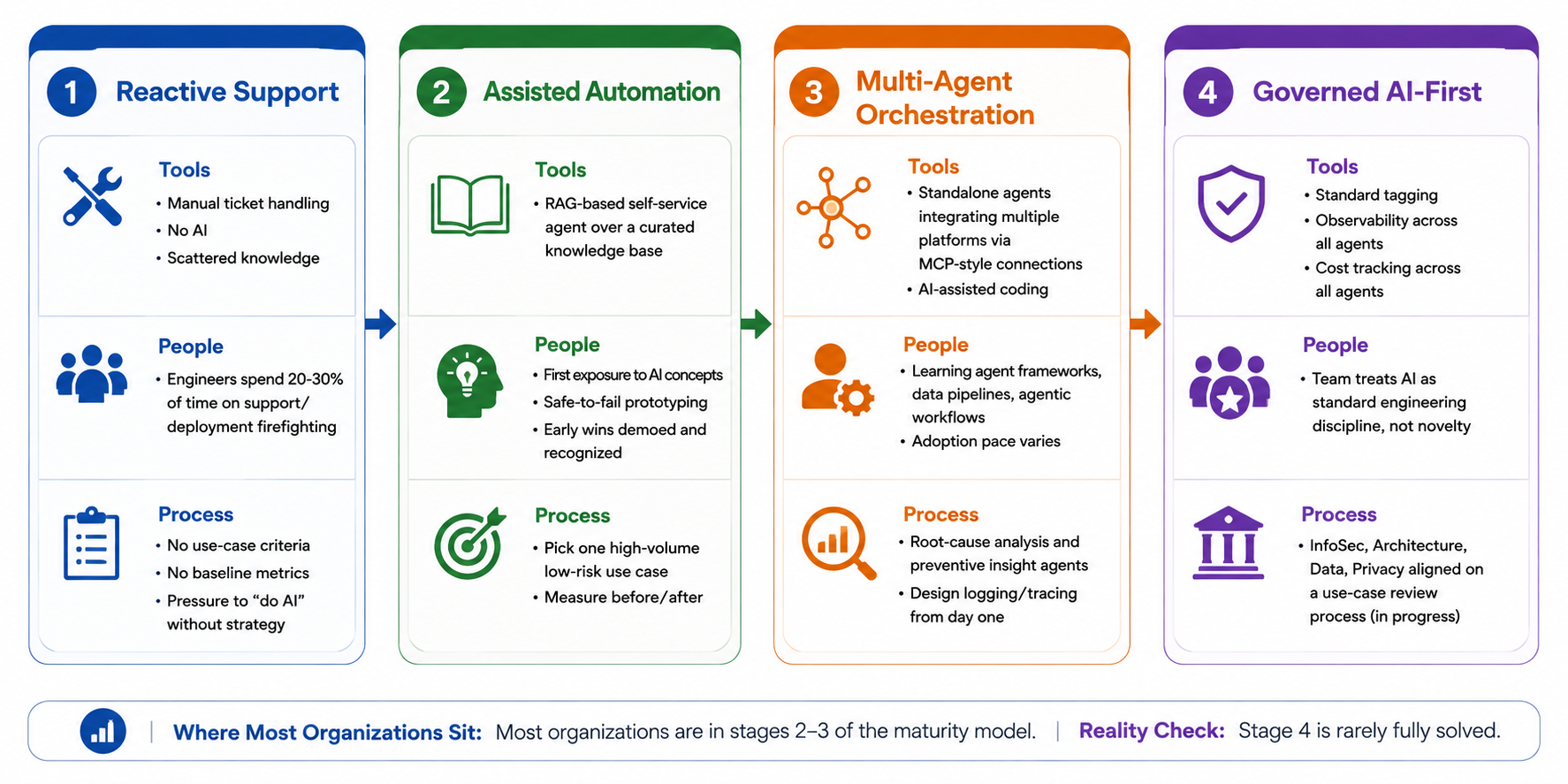
Stage 1 — Reactive Support
This is the starting point for most teams: manual, high-toil work, no AI assist, and knowledge scattered across docs and tribal memory. Engineers spend a significant chunk of their time — in our case, 20–30% — on support and operational firefighting instead of feature work. There's usually organizational pressure to "do AI" here, but no baseline, no strategy, and no clear use case yet. This is exactly the stage where the use-case checklist above matters most.
Stage 2 — Assisted Automation
The first real win usually comes from a narrow, high-volume, low-risk use case. For us, this was a RAG-based self-service agent — built on an existing low-code platform — that let engineering teams get answers without opening a ticket. The People track here is about giving the team a safe-to-fail environment to learn AI concepts (what RAG is, how a knowledge base gets curated and optimized) through building something real. Early wins get demoed back to the broader team, and the people who built them get recognized — this is what creates internal pull for the next stage instead of top-down mandate.
Stage 3 — Multi-Agent Orchestration
Once the team has working knowledge of AI concepts, they're ready to build standalone agents that pull data across multiple operational platforms — for example, agents that assist with root-cause analysis by correlating signals across systems. This is where the team gets real exposure to agent development frameworks, MCP-style integrations, and data pipelines. This stage is the most exciting and also the most fragile: it's easy to end up with several capable agents that don't talk to each other, aren't logged consistently, and can't be measured the same way.
Stage 4 — Governed AI-First
This is the frontier, not a finish line — we're actively in it, and it's the hardest stage to get right. It's where you formalize what's been built ad hoc: standard tagging and logging across agents, observability into what they're actually doing, and cost visibility. It's also where you bring in Enterprise Architecture, InfoSec, Data, and Privacy to define a review process for new AI use cases — not as a gate that slows things down, but as the guardrail that lets you scale with confidence. Most organizations, including ours, are still building this stage.
Metrics That Matter
Metrics only mean something with a baseline. For each of the categories below, capture "before" and "after," not just the after.
- Adoption metrics — % of team actively using AI tools, time-to-first-prototype, number of use cases in flight.
- Agent performance metrics — accuracy, response time, and reliability of the agents themselves, tracked over time.
- Productivity / business metrics — reduction in support ticket volume, reduction in release and deployment time, reduction in time spent on test authoring and code review.
- Cost metrics — compute and token spend measured against the value delivered, not just spend in isolation.
The goal isn't a dashboard for its own sake — it's being able to answer "was this worth it?" for every use case, honestly.
Lessons Learned (What We Underestimated)
Tools
1. Observability is a design decision, not an add-on. We were happy the team could build a working prompt wrapper around an LLM. But when we wanted real performance metrics, we realized you can't retrofit good logging and tracing onto an agent that wasn't designed for it.
2. Agent sprawl outruns governance if you let it. As agents got built across different tools, each made sense alone — but without shared tagging standards, getting one consistent metric across all of them became genuinely hard. Set a tagging standard as soon as you have more than one agent, not once you have ten.
3. Don't reinvent what the industry is already solving. We also learned not to build what emerging standards already handle. Adopting patterns like A2A for agent-to-agent communication and OpenTelemetry for tracing gave us interoperability and observability for free, instead of brittle, one-off integrations between agents.
Don't build what the industry is already standardizing — adopt open patterns, save your effort for the problem that's actually yours.
People
4. Adoption pace isn't a skill problem — it's normal. We assumed enthusiasm would spread evenly once the tools worked. It didn't. Some engineers went all-in immediately; others hung back, and that wasn't resistance — it was caution. Safe-to-fail environments matter more for the cautious adopters than for the early ones, and treating slower adoption as a training gap instead of a normal curve almost cost us their trust.
5. Early champions can quietly become a single point of failure. The engineers who built the first agents naturally became the go-to experts — which felt like a win until we noticed most agent knowledge lived with two or three people. Recognition for builders is good; making sure that knowledge doesn't stay siloed with them is a separate, deliberate effort.
Uneven adoption isn't a red flag — but uneven ownership is. Build for both speeds, and make sure knowledge doesn't stay locked in a few heads.
Process
6. Informal governance conversations should start before you think you need them. We waited until we had several agents in production before looping in InfoSec and Architecture formally. Every one of those conversations would have been faster and less disruptive if it had started as an early heads-up in Stage 2, not a formal review in Stage 4.
7. Without exit criteria, prototypes don't die — they just accumulate. We were good at starting use-case experiments and less disciplined about deciding when to kill or scale one. A use case needs a decision point defined at the start — not just a baseline to prove value, but a date or threshold to decide if it's worth continuing.
The best time to loop in governance is before you think you need to. The second-best time is now.
Who to Loop In Early
Waiting until Stage 4 to talk to these groups is the single most common way to slow yourself down later. Bring them in as observers as early as Stage 2:
- InfoSec — data handling and access boundaries for any agent touching real systems.
- Enterprise / Solution Architecture — how agents fit the broader platform roadmap, not just your team's stack.
- Data governance — where agent-generated data lives and who owns it.
- Privacy — especially relevant the moment an agent touches anything customer- or employee-adjacent.
You don't need their sign-off to prototype. You do need their awareness before you scale.
Closing Thought
None of this requires being an AI expert, and it doesn't require your team to be one either. It requires picking real problems, protecting a safe space to learn, measuring honestly, and building the boring infrastructure (logging, tagging, governance) before you're forced to. The teams that get this right aren't the ones with the flashiest agent — they're the ones who can explain, with numbers, exactly what it did for them.
Written from experience leading an enterprise platform engineering team through this exact journey — AI/MLOps, DevOps, test automation, performance testing, and monitoring — over the past year. No proprietary tools, data, or internal metrics are shared above; the framework is intentionally tool-agnostic so it applies regardless of your stack.